When the Growl in Your Stomach Has Something to Teach You
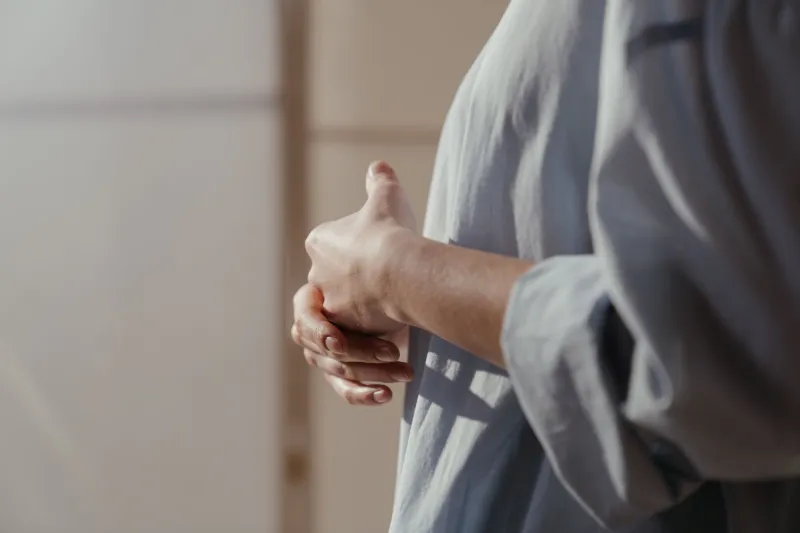
Let's be honest: most of us don't skip meals very well. Not because we're physically incapable of it, but because something inside us gets loud the moment we decide to try. There's a restlessness that kicks in around hour three of a fast that has very little to do with actual hunger. You know the feeling — you're not faint, you're not shaking, you're just... annoyed. Unsettled. Weirdly aware of every hour that passes without the thing you usually reach for.
That feeling? That's information. And it's worth sitting with.
Intermittent fasting has had a solid run in the wellness world over the past decade — 16:8 windows, OMAD protocols, the whole ecosystem of apps and trackers and before-and-after photos. And the metabolic research is genuinely interesting. But there's a layer of this conversation that tends to get skipped over in the nutrition content, and it might actually be the most important part.
What does your resistance to fasting tell you about how you relate to uncertainty, discomfort, and trust?
Fasting Is Older Than Your Fitness App
Pretty much every major faith tradition on earth has some version of fasting built into it. Ramadan. Yom Kippur. Lent. The fasting practices in Buddhism, Hinduism, and indigenous traditions across the Americas. This is not a coincidence.
For millennia, communities of faith recognized that voluntary abstinence — from food, from pleasure, from distraction — does something to a person that comfort simply can't. It creates space. And in that space, things surface that were previously buried under the noise of constant consumption.
The early Christian writers called it kenosis — a self-emptying. The idea wasn't deprivation for its own sake. It was the understanding that when you stop filling yourself up with the usual things, you become available to something deeper.
You don't have to be religious to find that compelling. But it helps to understand that this practice has a history longer than keto.
What Happens in Your Body When You Fast
Here's where the science gets interesting and, honestly, a little humbling. When you fast — even for a short window — your body does not immediately panic. It adapts. Insulin levels drop. Your cells begin a process called autophagy, essentially a self-cleaning mechanism where damaged cellular components get cleared out. Human growth hormone upticks. Inflammation markers often decrease.
Your brain, however, takes a little longer to get the memo. The psychological experience of fasting — especially in the first few days or the first few hours of a new practice — is largely driven by habit, not biology. Your stomach growls at noon not because your body is in crisis, but because it has been trained to expect something at noon.
That distinction matters. A lot of what we experience as need is actually habit dressed up as urgency.
Neuroscientists studying reward pathways have found that the anticipation of a habitual reward (food, scrolling, caffeine) triggers dopamine release even before the reward arrives. Which means that the discomfort of fasting isn't just about the absence of food — it's about the disruption of a neurological pattern your brain has come to depend on.
You're not just hungry. You're confronting the architecture of your own coping mechanisms.
The Control Question Nobody Wants to Ask
Here's the uncomfortable part. When you fast — from anything — and you feel that creeping anxiety, that "I need this" sensation, it's worth pausing to ask: What am I actually afraid of?
For a lot of people, the answer has nothing to do with food. It's about what food (or screens, or noise, or busyness) is doing beneath the surface. It's managing anxiety. It's filling silence that feels threatening. It's maintaining a sense of control over something — anything — in a world that feels persistently unpredictable.
We live in a culture that has normalized constant consumption as a coping strategy. The average American checks their phone 96 times a day, according to Asurion's research. We eat not just when we're hungry but when we're bored, stressed, lonely, or overstimulated. We fill every quiet moment with a podcast, a playlist, a notification.
None of that is moral failure. But it is worth examining. Because what we reach for when we're uncomfortable reveals what we actually trust to save us.
Fasting as a Practice of Surrender
This is where fasting becomes genuinely spiritual — not in a performative, Instagram-worthy way, but in a quietly radical one.
When you choose to sit with hunger — whether it's hunger for food, for entertainment, for reassurance — and you don't immediately fill it, you are practicing something ancient and countercultural: trust that you will be okay without the thing.
In faith terms, this is surrender. Not resignation, not passivity, but the active decision to loosen your grip on the mechanisms you use to feel safe.
Matthew 6 has Jesus assuming his followers will fast ("when you fast," not "if"), and the instruction is notably private — not for show, not for validation. Just a quiet, personal act of reorientation. I am not sustained by bread alone. That's a theological statement, yes. But it's also a psychological one. It's a declaration that you are more than your appetites.
Practical Starting Points That Aren't Overwhelming
You don't have to dive into a 24-hour water fast to explore this territory. Start smaller and pay attention.
Try a 12-hour overnight fast. Finish dinner by 7 PM and don't eat until 7 AM. This is gentle, manageable, and gives you a window to notice what arises in the morning before you eat. Are you calm? Anxious? Reaching for your phone before your feet hit the floor?
Do a half-day screen fast one day a week. No social media from dinner to noon the next day. Notice the pull. Notice what you want to check and why. That awareness alone is valuable data.
Fast from one comfort habit for a week. That third cup of coffee. The late-night snack. The TV you turn on the moment you walk in the door. Not because these things are bad, but to see what's underneath them.
With each fast, try journaling just one sentence: What am I afraid will happen if I don't have this? The answers tend to be illuminating.
What You Find in the Empty Space
Here's what most people discover somewhere in the middle of a fast, once the initial restlessness settles: they're still here. Still okay. The world didn't end because they skipped lunch or logged off for a day. And in that quiet, something often surfaces — clarity, creativity, a sense of presence they hadn't felt in months.
Fasting doesn't create that. It just clears enough room for it to show up.
That's the invitation. Not deprivation. Not willpower as a virtue signal. Just a deliberate, temporary loosening of the grip — on food, on comfort, on control — and a willingness to see what's there when you stop filling every gap.
Your hunger pangs might have more to say than you've been giving them credit for. The question is whether you're willing to listen before you reach for whatever's in the fridge.