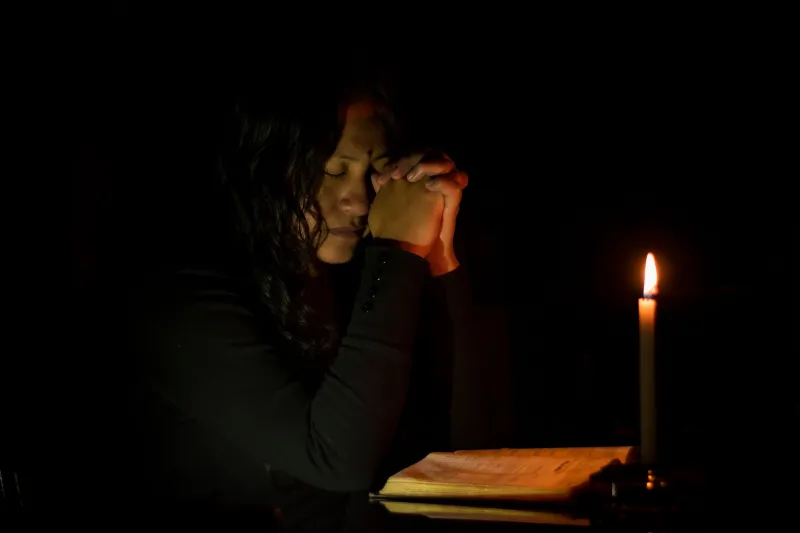
3 AM and Wide Awake: What Your Sleepless Nights Are Really Trying to Tell You

Photo: Rembrandt, Public domain, via Wikimedia Commons
When the Lights Go Out, the Noise Gets Louder
You know the feeling. The house is finally quiet. You've done everything right — turned off the TV, put your phone face-down, maybe even made chamomile tea. And then you lie there, staring at the ceiling, while your mind replays every awkward conversation, every unpaid bill, every unanswered prayer from the last six months.
This isn't just bad sleep hygiene. For a lot of us, those midnight spirals are a signal — one our bodies are sending on behalf of something much deeper.
The connection between spiritual unrest and physical sleeplessness is real, and it's more measurable than you might think. Understanding what's actually happening inside you when anxiety hijacks your rest is the first step toward doing something about it.
What Cortisol Has to Do With Your Faith Life
Here's the biology, kept simple: when your brain perceives a threat — whether that's a lion in the grass or a fear that God has forgotten about you — it triggers the release of cortisol, your body's primary stress hormone. Cortisol is genuinely useful in short bursts. It sharpens your focus and gets your body ready to respond.
The problem is that your nervous system doesn't distinguish between a physical danger and an emotional or spiritual one. Chronic worry, unresolved guilt, long-held grief, or a quiet but persistent sense that something is wrong — these all register as threats. And a body flooded with cortisol at 2 AM is a body that absolutely cannot fall into the deep, restorative sleep stages it needs.
Research published in journals like Sleep Medicine Reviews has consistently linked elevated nighttime cortisol to disrupted REM sleep, reduced sleep duration, and early morning waking. What the research often doesn't say out loud is that emotional and spiritual distress are among the most common drivers of that cortisol spike.
In other words: your racing thoughts aren't just annoying. They are physiologically keeping you awake.
The Specific Kind of Fear That Keeps You Up
Not all anxiety is created equal, and midnight anxiety has its own particular flavor. Sleep researchers sometimes call it "hyperarousal" — a state where the brain stays stuck in high alert even when the body is exhausted. Spiritually speaking, this often shows up as:
- Fear-based rumination — replaying worst-case scenarios on a loop
- Doubt spirals — questioning decisions, relationships, or your sense of purpose
- Unconfessed or unprocessed guilt — the stuff you've pushed down but haven't actually dealt with
- Grief that hasn't had space to breathe — loss that gets ignored during busy days but surfaces when everything goes quiet
If any of those land for you, you're not broken. You're human. But you also don't have to white-knuckle your way through another sleepless night.
A Breathing Practice That Interrupts the Cycle
Before we get to the spiritual side, let's talk about a tool that works fast — because sometimes you need something that works right now, at 3 AM, when you're not in a great headspace for deep reflection.
Box breathing, used by everyone from Navy SEALs to trauma therapists, directly activates your parasympathetic nervous system — the part responsible for "rest and digest" rather than "fight or flight." Here's how to do it:
- Inhale slowly through your nose for a count of 4
- Hold at the top for a count of 4
- Exhale through your mouth for a count of 4
- Hold at the bottom for a count of 4
- Repeat for 4–6 cycles
As you breathe, try pairing each exhale with a single repeated phrase — something like "I release this to You" or simply "peace." This isn't just poetic. Repetitive, rhythmic thought patterns during controlled breathing help interrupt the rumination loop by giving your mind a gentle anchor.
Surrender Meditation: Giving It Back Before You Sleep
This is the part that changes things for a lot of people, and it's deceptively simple.
Before bed — or when you wake in the middle of the night — try what we call a surrender practice. It's not a formal prayer if that feels stiff to you. It's more like a conscious, intentional act of setting something down.
Here's a loose structure:
Acknowledge. Name what's actually bothering you. Don't spiritually bypass it with "I'm fine, God's got it." Say it plainly, even if only in your head: I am scared about my job. I am still hurting over what happened with my sister. I don't know what comes next and that terrifies me.
Offer. Then — and this is the active part — physically open your hands (yes, literally unclench them) and say something like: I don't have the answer to this tonight. I'm choosing to put it down until morning.
Receive. Spend 60 seconds simply breathing and imagining what it would feel like to not carry that thing. Not fixing it. Just not holding it.
This practice is rooted in the ancient concept of surrender found across faith traditions — the idea that rest is not earned through having everything figured out, but received when we stop trying to control what we can't.
Scriptural Affirmations That Work Like Anchors
If scripture is part of your faith life, certain verses function almost like neurological anchors when repeated during anxious moments. The key is repetition and slowness — not rushing through them, but letting each word land.
A few that readers have found particularly grounding at night:
- "He grants sleep to those He loves." — Psalm 127:2
- "When you lie down, you will not be afraid; when you lie down, your sleep will be sweet." — Proverbs 3:24
- "Cast all your anxiety on Him because He cares for you." — 1 Peter 5:7
Choose one. Write it on a sticky note and put it on your nightstand. When your mind starts to spiral, return to it the way you'd return to your breath in meditation.
Making Peace With the Night
Here's what we want you to take from all of this: your sleeplessness is not a character flaw, and it's not something you just need to push through. It's a message. Your body and your spirit are in conversation, and the midnight hours — as inconvenient as they are — have a way of making that conversation impossible to ignore.
The goal isn't to silence the anxiety through sheer willpower. It's to create enough space — through breath, through surrender, through the quiet anchor of faith — that your nervous system can finally believe it's safe to rest.
You were made for sleep. Real, deep, restorative sleep. And with a little practice, your body will remember how to find its way back to it.